All posts by ariah

Female Pronouned God Experiment: Week 1 Review

For the past week, I’ve been referring to God as “She” or “Her” when the need to use a pronoun arises. I mentioned this experiment on the blog last week and it brought with it a string of conversation I found very interesting. It’s also shaped some of my thoughts through out the week. You really should go read the comment section on the post, there are a lot of great thoughts. I felt a clarification or two might be in order.

This Is An Experiment

I think experimenting is important (don’t take that the wrong way). Christians especially are notorious for our sort of black and white stances on so many things. Sometimes I think it’s justified, but many times I think it’s not. When I decided to spend the month referring to God as “She” I did not make a fundemental switch in my doctrine or theology. I’m not making a definitive statement of the gender of God or even of my social or political leanings. If I decide to go back to referring to God as “He” come January, I don’t think any irreversable damage will be done. I think we need to be open to trying new things, hearing other opinions, walking a mile in another persons shoes. This is just an attempt to do that in a small way.

Men and Women have experienced life Differently

Regardless of what you think about gender, gender roles, sexual orientation, societies stereotypes, and more, there is the undeniable reality that we have been shaped by our experience; and men and women’s life experience is fundamentally different. I’m not attempting to make any statement about biology or innate traits of men and women, I’m simply acknowledging that the way we are treated as “boys” and “girls” affect the types of adults that we become. One way I believe we’ve been shaped differently is in our understanding and connection with “God”. The reality that we have almost all grown up with God being a “He” has an impact on us, particularly differently if we ourselves are “he” or “she”.  That being the case, this experiment is also an opportunity to see this small aspect of my life differently then I have for the past 26 years.

I’ll try and share more of my thoughts thus far on the actual practice of calling God “She” later this week if I can. For now, I hope these two points open your mind a bit to what this is about.

[photo credit]

Capricious Thursday: Better Than Sliced Bread

Do not be too moral. You may cheat yourself out of much life. Aim above morality. Be not simply good; be good for something. -Henry David Thoreau

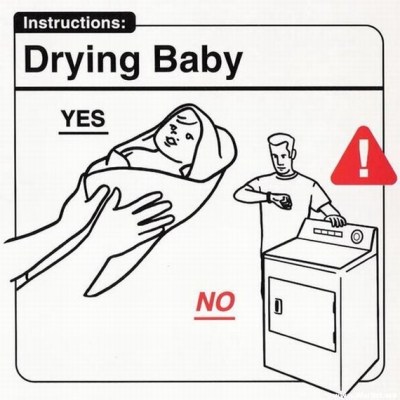
How to dry a baby

The ultimate measure of a man is not where he stands in moments of comfort and convenience, but where he stands at times of challenge and controversy. -MLK

I wish I had written this book via dktoday:www.beawesomeinstead.com

You are never going to build a church by kicking people out. This isn’t a fast-food restaurant; it’s the kingdom of God, and quality disciples take a lot of time. Jesus is patient to the end. -donald miller in Searching for God Knows What

New Friend Requests

It’s not your salary that makes you rich, it’s your spending habits.
-Charles A. Jaffe

Now this is a “Christian” Billboard

We don’t save souls…

We just make sure there is no booze or porn on their life raft.
-Keane

I Died For Your Grins

Book Review: Sway by Ori and Rom Brafman

Looking for a quick and interesting read, I picked up Sway: The Irresistible Pull of Irrational Behavior, by Ori and Rom Brafman. In the vein of Freakonomics, The Tipping Point and others (don’t know what that genre’s called). The book proved thoroughly interesting.

The basic premise is that we are swayed to act irrationally by various external forces. By learning and being aware of them we can learn to make more rational decisions, though the reality is we our often affected so sub-consciously by these forces that they are hard to avoid.

Rather then summarizing the different Sways myself, I found an excellent summary over at JollyBlog‘s book review:

Loss aversion – this is a form of playing not to lose, making decisions in order to cut our losses, or avoid further losses.

Commitment – this is our tendency to hold fast to our course of action in the face of accumulating losses.

Value attribution – we attribute value to people or things based on quick impressions.  In other words, if the right people like something we attribute greater value to that thing than if the wrong people like it.

Diagnosis bias – once we diagnose a situation we see the world through the lens of that diagnosis and all of reality conforms to our bias.

Fairness perception – we’ll often act against our own best interests if we feel that we are being treated unfairly.  There is a cool experiment he talks about involving two subjects.  Someone offers them a sum of money, let’s say $100.  One person gets to divide it any way they want and the other person can decide to accept or reject that division.  If the second accepts they both get the money per the division by the first.  If the second rejects, they both get nothing.  Most of the time the first person divides it 50-50, the second accepts and they walk away happy.  But, when the first person makes an imbalanced division – let’s say he keeps $70 and offers the other $30 – in pretty much every case the second rejects it.   In either case, whether it was a 50-50 or a 70-30 split, the second person would have come out to the good, but in the second case they rejected their own gain because of the fairness perception.

Altruism-Pleasure conflict – people will perform better for altruistic motives than for rewards.  In other words, if someone does something for altruistic motives and then you come back and offer them a reward for doing the same thing, you will often find them losing motivation and/or performing worse.  You gotta read that chapter to understand how it works.

Group Conformity – when in group settings, people tend to stifle their own opinions, often when their own opinions are patently correct and the groups are patently false, to go along with the group.

I’d recommend this book to anyone whose enjoyed any other books in this genre. It’s a quick and easy and interesting read. For some further insight into the subject matter here’s a video by the author about the book.

Now, some totally random tidbits that don’t necessarily give you a good overall view of the book, but might be interesting nonetheless.

Apparently LBJ was a pretty crazy guy…

“There’s a thin line between determination and intimidation and LBJ had no trouble skipping between the two. When he was elected to Congress, he’d call fellow legislators at all hours of the night, just to catch them off guard. Later, as president, during official White House meetings he’d shock and intimidate visitors by announcing a swimming break, taking off his clothes and jumping naked into the pool.” (p.33)

They did a study where a college class has a surprise substitute teacher. The students receive different descriptions of the teacher, an identical biographic paragraph except one line: “People who know him consider him to be a very warm person…” or “People who know him consider him to be a rather cold person…” After sitting through the class, hearing from the exact same professor, the students fill out a questionnaire. Those who had the “very warm” description described the teacher as such. Yet, students who’d sat through the exact same class but who’d received the “rather cold” description described the professor as “self-centered, formal, unsociable, unpopular, irritable, humorless, and ruthless.” One word difference completely changed their perception of the same person! (p.73)

The book also references studies challenging the effectiveness of SSRI’s (Prozac, Zoloft, etc)

“When it comes to SSRIs and children, only three out of the sixteen randomized control trials they had for kids showed a positive result. Only three out of sixteen. And of course there is also the risk of serious side effects.” -Dr. David Antonuccio, regarding research on SSRI’s (p. 97)

The Season Is About The Children

As I’ve said in the past, I’ve struggled in recent years with the Christmas season. And I’m making an effort to stay positive this year. This past Sunday I had a beautiful glimpse of what I think the season is about, or should be more about if anything.

After Thanksgiving, we had the chance to go to church with some dear friends of ours whom we lived with in Nashville who now live in Iowa. On the first Sunday of Advent they had their three children dedicated at the church they attend. They have three wonderful, beautiful free-spirited little ones whom they love.

I think typically most of the kids our in the nursery during the service, but that day they had their three kids and we had our daughter all in the service. As you can imagine they didn’t sit still and silent the whole time. During the singing, the lighting of the advent candle, the children s sermon and more, the kids wandered around and explored, smiled, said “hi” to the person behind us and grunted in frustration at times. My initial instinct was concern for being polite and respectful of those around us and making sure my daughter kept quite and out of the way.

Fortunately, the Christmas singing set me straight. I don’t know what song it was but some line about baby Jesus reminded me that we are celebrating a birth, we are celebrating a child, hope for humanity comes to us packaged in a whiney, messy, crying, smelly, wandering, giggling, antsy, tired, noisy, lovely little child.

And I was able to sit back and let the kids enjoy themselves. I think God must have smiled and cried a little as She* watched that scene unfold in Bethlehem 2000 some years ago. It brought a tear to my eye that day as I watched the kids run around, in many ways my hope for humanity is tied up in their lives.

I don’t mean that as an encouragement to shower kids with presents or take frequent trips to see Santa in the mall. I think instead we need to be reminded that what we celebrate this season is that the hope of humanity came through a child, and it is carried on through us (children who have grown to love our neighbors and raise the next generation of children to do the same). Remember, this season is about the children.

*An explanation of why I’m using female pronouns for God.

My December Experiment: Female Pronouned God

For 26 years I’ve grown up hearing “God” referred to with male pronouns. Occasionally it’s acknowledge that God is neither male nor female, but following the tradition of our male-centric, paternalistic society (and original bible writers) we refer to God as a male, frequently and often.
For reasons, whether doctrinal or societal, we are hesitant to move away from, in any way, referencing God (specifically the God God part of the trinity [Jesus, Holy Spirit, God]) in any feminine term or pronoun.  Any attempt to do so is often written off as “new agey” or “feminist” as if referring to God as a “he” is one of the central doctrinal issues of our faith. Yet, we do acknowledge that God is spirit, and though extremely rare there is scripture acknowledging female attributes of God.
The truth is that both males and females have been impacted by this “male” God and what that means for us as people, individuals and within our gender. My wife has spoken about the impact she’s felt it’s had on her, not just of seeing God as male, but the near silence or absence of woman’s value and voice in the scriptures she sees as the foundation of her faith.
One month is not nearly enough to reverse any long term psychological impact, but for the month of December (or longer), I’d like to refer to God as a female (with female pronouns). We currently do this to a small degree in our own home, but I haven’t moved beyond.
I’ll refer to God as “she” in my blog posts (I’d encourage others whom I read or read here to do this as well), around and amongst family and friends, and in any other “God” talk. I won’t go out of my way to say it and make a scene, but I won’t shy away from it either.
I’ll write about the impact the experiment has had on me and how I think about God.
I’d love to hear your feedback or thoughts on this topic, and if there are any others who want to experiment with me I’d love to have some fellow adventurers.

Others Thoughts On Thanksgiving

I’ve tried a couple times in the past years to reflect on Thanksgiving, this time I didn’t really know what to say. I’ll leave you with a couple articles I’ve read that I found encouraging.

My only thought this thanksgiving is that I’m going to try and eat a proper amount for myself. Not too much. If there is any way that I could start this holiday season properly it’s to avoid gluttony and keep in mind so many in the world who don’t have enough.

Youtubesday: Camilo, Louis CK, and Dancing Honey Bees

Some how ended up with this sweet song in our itunes, the lyrics sounded good so I looked up more info, here’s a great music video of the song, Camilo, by State Radio, about Camilo Ernesto Mejía

A funny comedian, Louis CK, on Conan discussing modern conveniences

And if stand-up isn’t your thing, you’ll definitely enjoy this BEE-Boy Video, seriously, watch this now.

(the website is actually about the disappearing Honey bee population, it’s sponsored by an ice cream company, but it’s at least a worthy topic)

Finally, Another Blog Redesign

Well, I had nothing in the brain to write for this week, zero posts lined up, so I went ahead and redesigned the whole website. I’ve been working on a few design projects and it inspired me to clean this site up as well. I’m hoping to utilize images a bit more as you’ll see if you go to the home page. Maybe this clean new design will entice some of you email and rss voyeurs to stop by every once in a while.

I think I kept the old design up for almost two years, which is impressive by my standards. I managed to write rather then procrastinate by dabbling in the look of the site. Hopefully this new look will remain for a few years to come as well.

I still have to clean up the sidebar and some of the other features of the site, but all web projects are always in progress. So that’s it for now, nothing fancy, just a note to say stop by and see what you think of the new look. (my secret wish is that this amazing new redesign will push my readership over 300… tell your friends)

Book Review: Terrorism and War by Howard Zinn

https://tryingtofollow.com/wp-content/linkedimages/upload//images/14990000/14994502.JPGI just read through Terrorism and War by Howard Zinn, and I’d recommend it to anyone who wants to hear a brilliant mind on the current issues of war and terror. The whole book is just over one hundred pages and it’s in an interview format, as it basically is a compilation of a series of interviews Zinn gave around 2002, just after 9/11 and the Afghanistan war and just before the Iraq war. Zinn is a truly brilliant mind and I feel makes a decent case that war is simply not a useful tool anymore, period.

Some Quotes…

“I think there is a simple test of what concerns bin Laden, whether it is our democracy and internal freedom or whether it’s our foreign policy. And that simple test is: What side was Osama bin Laden on before 1990? That is, before the United States stationed troops in Saudi Arabia, made war against Iraq, and began its sanctions against Iraq. We were just as democratic and libertarian internally before 1990 as we are today. But Osama bin Laden was not offended by that. He was on our side — and we were on his side — in the fight to take control of the government in Afghanistan. The turning point for Osama bin Laden is very clear. It has nothing to do with democracy and liberty. It has to do with U.S. foreign policy. And that turning point came in 1990 and 1991.” p. 13

Speaking of alternatives to war…

The question always comes up about World War II: “What would you have done?” The answer is not an easy one, but it has to start off by saying, “I would not accept a solution that involves mass killing. I would try to find some other way.” The other way is not passivity; the other way is not acceptance; the other way is resistance without war. The other way is underground movements, strikes, general strikes, noncompliance. Even Hitler, in World War II, was at times successfully resisted in Denmark, in Norway, in Germany itself, by wives protesting the deportation of their Jewish husbands. Those methods of resistance don’t ensure a peaceful resolution, because the repressive forces are always strong. But they are means that are more proportional to the end, especially since they are means that are engaged in not by governments but by people, which is a very important consideration. With popular resistance, you have a greater assurance that your end will be attained than if governments are in charge. p. 23-24

On why he doesn’t call himself a pacifist…

I have never used the word “pacifist” to describe myself, because it suggests something absolute, and I am suspicious of absolutes. I want to leave openings for unpredictable possibilities. There might be situations (and even such strong pacifists as Gandhi and Martin Luther King believed this) when a small, focused act of violence against a monstrous, immediate evil would be justified. p. 25

A tidbit that was noted in the book:

According to an article in the Boston Review, “up to 35 million people-90 percent civilians-have been killed in 170 wars since the end of World War II. (Boston Review 24, no. 1, Gabriel Kolko, Century of War: Politics, Conflict, and Society Since 1914)

And I’ll finish with a final quote from the book, of Dwight Eisenhower, our 34th President:

Every gun that is made, every warship launched, every rocket fired, represents, in the final analysis, a theft from those who hunger and are not fed, who are cold and are not clothed. This world in arms is not spending money alone. It is spending the sweat of its laborers, the genius of its scientists, the hopes of its children.